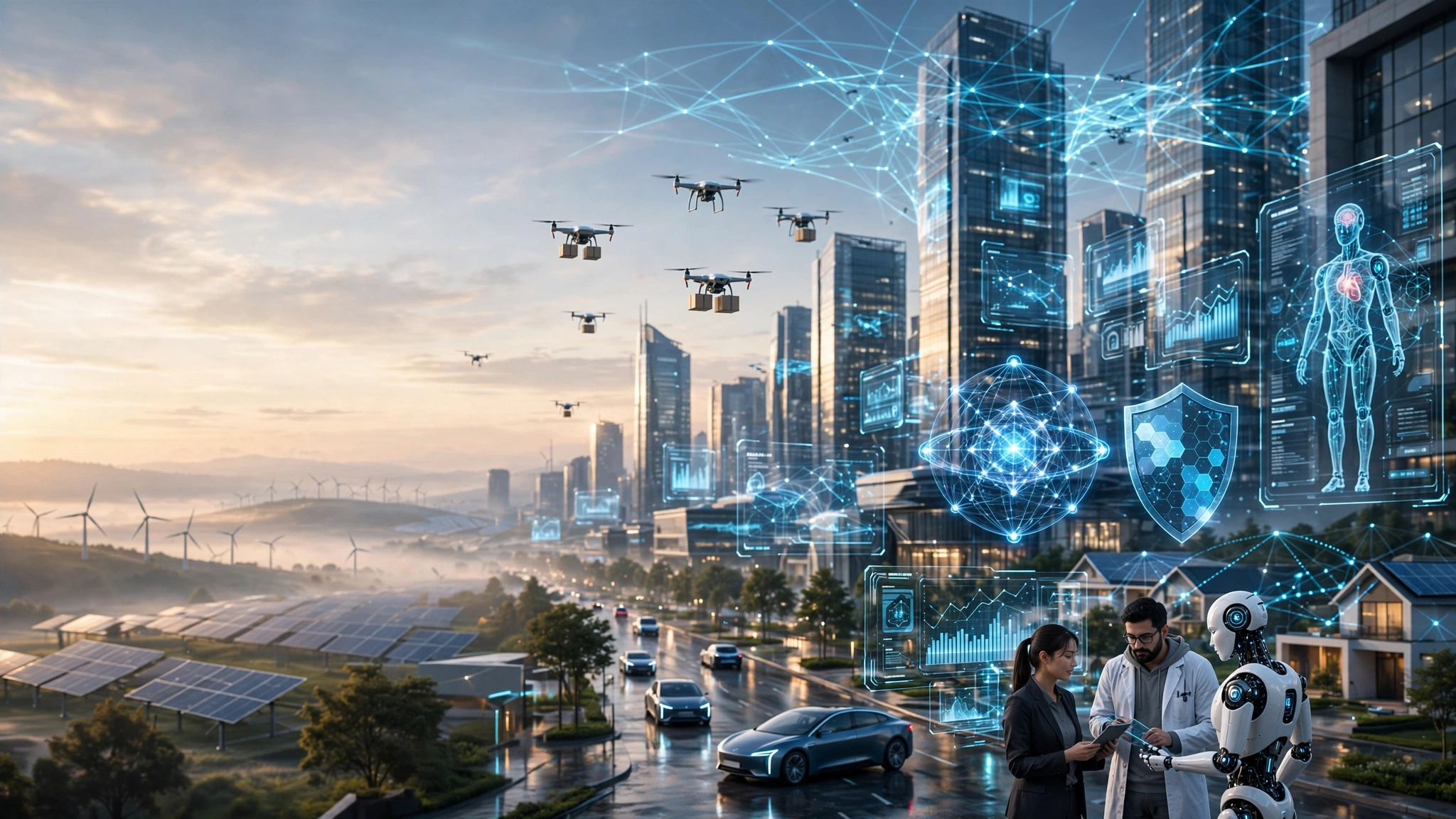

Technology has always evolved at a remarkable pace, but 2026 marks a turning point where artificial intelligence, automation, quantum computing, cybersecurity, and sustainable innovation are becoming deeply integrated into everyday life. Businesses are no longer experimenting with emerging technologies—they are deploying them at scale to improve productivity, reduce costs, strengthen security, and deliver better customer experiences. At the same time, consumers are experiencing smarter devices, faster connectivity, and more personalized digital services than ever before.
From AI-powered workplaces to intelligent robots, from quantum breakthroughs to digital trust systems, the technology landscape of 2026 is defined by practical adoption rather than futuristic promises. Organizations across healthcare, finance, education, manufacturing, and retail are embracing these innovations to remain competitive in an increasingly digital world. According to industry research from Gartner, IEEE, the World Economic Forum, Stanford University, and Forrester, several technologies are emerging as the defining trends of 2026.
This article explores the latest technology trends in 2026, explaining how they work, why they matter, and how they are changing businesses and daily life.
Artificial Intelligence Continues to Lead Innovation
Artificial Intelligence (AI) remains the most influential technology trend of 2026. However, the conversation has shifted beyond simple chatbots and content generation. Today’s AI systems are capable of reasoning, planning, analyzing complex data, and supporting decision-making across industries.
Businesses now rely on AI assistants to automate repetitive tasks, summarize reports, manage customer interactions, and generate software code. Healthcare providers use AI to assist doctors in medical imaging, disease detection, and personalized treatment planning. Financial institutions apply AI to detect fraud in real time and assess investment risks with greater accuracy.
Another significant development is the rise of AI agents that can perform multi-step tasks independently while collaborating with humans. Rather than replacing workers, these systems increasingly act as digital teammates that improve productivity and reduce manual workloads. IEEE predicts AI agents will become standard across business environments, eliminating many routine administrative tasks.
Physical AI and Smart Robotics
One of the biggest technology shifts in 2026 is the expansion of Physical AI, where artificial intelligence moves beyond software into machines that interact with the physical world.
Modern robots are becoming more adaptive thanks to AI-powered vision systems, advanced sensors, and continuous learning capabilities. Warehouses now use intelligent robots for inventory management, factories deploy autonomous production systems, hospitals utilize robotic assistants for logistics, and agriculture benefits from AI-driven harvesting and crop monitoring.
Unlike earlier industrial robots, today’s intelligent machines can recognize changing environments, avoid obstacles, and collaborate safely alongside human workers.
Industry experts identify Physical AI as one of the most transformative trends because it bridges digital intelligence with real-world operations.
Generative AI Becomes a Business Standard
Generative AI has matured significantly during 2026. Rather than serving only as a content creation tool, it has become an essential component of enterprise workflows.
Organizations now use generative AI for:
- Software development
- Marketing content creation
- Customer support automation
- Legal document drafting
- Financial reporting
- Product design
- Internal knowledge management
Businesses are also adopting domain-specific language models trained on industry-specific data to improve accuracy and regulatory compliance.
Instead of replacing employees, successful companies are integrating AI into existing workflows, allowing professionals to focus on strategic thinking while automation handles repetitive work. Gartner identifies AI-native development platforms and domain-specific AI models as key strategic priorities.
Quantum Computing Enters Practical Development
Quantum computing is no longer viewed as distant research. Although fully fault-tolerant quantum computers remain under development, 2026 has seen significant progress toward commercial applications.
Rather than replacing traditional computers, quantum processors are increasingly working alongside classical computing systems through hybrid computing architectures. This allows organizations to solve optimization, molecular simulation, logistics, and scientific research problems that are extremely difficult for conventional computers.
Industries expected to benefit most include:
- Drug discovery
- Materials science
- Financial modeling
- Climate research
- Logistics optimization
- Cryptography
Experts emphasize that hybrid quantum-classical systems represent the future rather than standalone quantum machines.
Cybersecurity Evolves with AI
As technology advances, cyber threats become more sophisticated. In response, cybersecurity is shifting from reactive defense toward proactive threat prevention.
AI-powered security platforms now monitor networks continuously, detect unusual behavior instantly, and respond to attacks before major damage occurs.
Organizations are also preparing for the future impact of quantum computing by implementing post-quantum cryptography, which protects sensitive information against future quantum-based attacks.
Another growing focus is Digital Provenance, allowing businesses to verify whether digital content, software, or AI-generated material is authentic and trustworthy.
Cybersecurity is no longer viewed as an IT responsibility alone—it has become a core business strategy.
Edge Computing Powers Real-Time Intelligence
Cloud computing remains essential, but Edge Computing is expanding rapidly as organizations require faster processing with lower latency.
Instead of sending every piece of data to distant cloud servers, edge devices process information locally, enabling faster decision-making and reduced bandwidth usage.
Common applications include:
- Autonomous vehicles
- Smart manufacturing
- Healthcare monitoring
- Industrial automation
- Smart cities
- Retail analytics
Edge AI combines local computing power with artificial intelligence, allowing devices to make intelligent decisions even without constant internet connectivity.
This distributed computing model improves reliability, privacy, and response times across many industries.
Spatial Computing and Mixed Reality Expand
Virtual Reality (VR) and Augmented Reality (AR) are evolving into Spatial Computing, where digital content interacts naturally with physical environments.
Businesses now use spatial computing for:
- Employee training
- Engineering simulations
- Product visualization
- Healthcare education
- Remote collaboration
- Retail experiences
Instead of existing as entertainment technology alone, spatial computing is becoming an important business tool that improves learning, design, and communication.
As hardware becomes lighter and software more capable, adoption continues to increase across multiple industries.
Smarter Internet of Things (IoT)
Billions of connected devices continue generating enormous amounts of data. In 2026, IoT is becoming significantly smarter through AI integration.
Connected systems can now analyze data automatically instead of simply collecting it.
Examples include:
- Smart factories predicting equipment failures
- Homes optimizing energy consumption
- Hospitals monitoring patients remotely
- Cities managing traffic efficiently
- Farms improving irrigation automatically
The combination of AI, IoT, cloud services, and edge computing creates highly intelligent ecosystems that operate with minimal human intervention.
Green Technology and Sustainable Innovation
Technology companies are increasingly prioritizing sustainability alongside innovation.
Green technology trends include:
- Energy-efficient AI infrastructure
- Smarter data center cooling
- Renewable energy management
- Electric vehicle integration
- Everything-to-grid energy systems
- Low-carbon manufacturing
Organizations recognize that sustainable technology not only reduces environmental impact but also lowers operating costs and supports long-term business resilience.
The World Economic Forum identifies clean energy technologies and efficient infrastructure among the most promising innovations entering large-scale adoption.
Personalized Healthcare Through Technology
Healthcare continues to experience rapid digital transformation.
Artificial intelligence now supports doctors in diagnosing diseases, analyzing medical images, and recommending personalized treatment plans.
Wearable devices monitor heart rate, sleep quality, blood oxygen levels, and physical activity while sharing data securely with healthcare providers.
Researchers are also advancing adaptive bio-AI systems capable of monitoring biological signals continuously to improve treatment outcomes.
These technologies aim to deliver more accurate diagnoses, earlier intervention, and improved patient care.
AI Infrastructure and Advanced Computing
The rapid growth of AI applications requires more powerful computing infrastructure.
Organizations are investing heavily in:
- AI supercomputers
- High-performance GPUs
- Specialized AI chips
- Advanced semiconductor manufacturing
- High-speed networking
- Efficient data centers
Countries are also increasing investments in semiconductor production to strengthen technological independence and meet growing demand for AI hardware.
The race to develop next-generation computing infrastructure has become a strategic priority worldwide.
Trust, Privacy, and Responsible AI
As AI systems become more powerful, governments and businesses are paying closer attention to ethics, transparency, and accountability.
Key priorities include:
- Responsible AI governance
- Data privacy protection
- Transparent AI decision-making
- Bias reduction
- Compliance with regulations
- Digital identity protection
Consumers increasingly expect organizations to explain how AI systems make decisions and how personal information is collected, stored, and protected.
Responsible AI practices are becoming a competitive advantage rather than simply a legal requirement.
The Future of Work in 2026
Technology is reshaping workplaces rather than eliminating them.
Employees increasingly work alongside AI assistants that automate repetitive administrative tasks while humans focus on creativity, leadership, communication, and strategic thinking.
Businesses are investing heavily in digital skills, AI literacy, cybersecurity awareness, and continuous employee learning.
The most successful organizations view technology as a tool that enhances human capabilities instead of replacing them.
Conclusion
The latest technology trends in 2026 demonstrate that innovation is no longer limited to research laboratories or experimental projects. Artificial intelligence, robotics, quantum computing, edge computing, cybersecurity, spatial computing, and sustainable technologies are now delivering measurable value across industries.
Businesses adopting these technologies are improving efficiency, enhancing customer experiences, strengthening security, and unlocking entirely new opportunities for growth. At the same time, individuals benefit from smarter healthcare, intelligent devices, personalized services, and more connected digital experiences.
As technology continues to evolve, the organizations and professionals who embrace continuous learning and responsible innovation will be best positioned for success. While no one can predict every breakthrough ahead, one thing is clear: 2026 is shaping the future through intelligent, secure, and human-centered technology.
Frequently Asked Questions (FAQs)
1. What is the biggest technology trend in 2026?
Artificial Intelligence (AI) remains the biggest technology trend in 2026, with widespread adoption across healthcare, finance, education, software development, manufacturing, and customer service.
2. Is quantum computing replacing traditional computers?
No. Quantum computing complements traditional computers rather than replacing them. Hybrid computing systems combine classical and quantum technologies to solve highly complex problems more efficiently.
3. Why is cybersecurity becoming more important in 2026?
As AI, cloud computing, and connected devices expand, cyber threats become more advanced. Organizations are investing in AI-powered security, digital trust systems, and post-quantum cryptography to protect sensitive information.
4. How are businesses using AI in 2026?
Businesses use AI for customer support, software development, document creation, fraud detection, predictive analytics, workflow automation, marketing, and business intelligence.
5. Which industries are benefiting most from emerging technologies in 2026?
Healthcare, manufacturing, finance, education, logistics, retail, agriculture, transportation, and energy are among the industries experiencing the greatest benefits from AI, robotics, edge computing, and advanced digital infrastructure.
Read more 15 Proven Business Growth Tips for Small Businesses to Increase Sales in 2026